Understanding Cultural Differences Through the Culture Map


In an increasingly globalized environment, communication across cultures has become an essential skill within business, marketing, and creative industries. Digital platforms connect people internationally, but differences in communication styles, decision-making, and trust-building can still create misunderstandings and inefficiencies (Meyer, 2014).
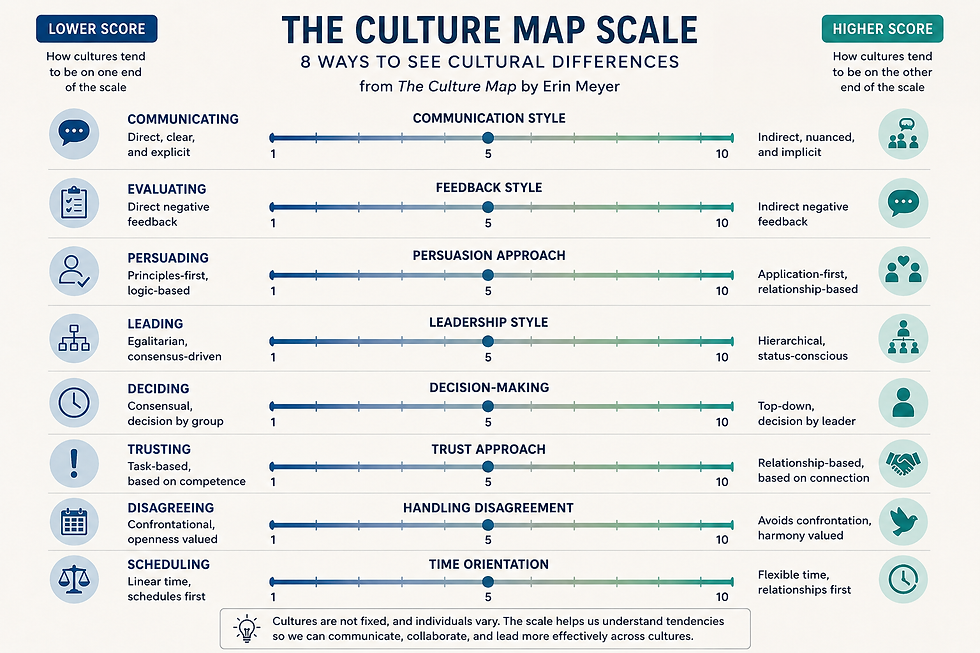
In The Culture Map, Erin Meyer explores how cultural differences influence the way people communicate, collaborate, evaluate performance, and build relationships in professional environments. Rather than viewing culture through stereotypes, Meyer presents culture as a spectrum of behavioural tendencies that shape interaction in subtle but significant ways (Meyer, 2014).
This blog reflects on several concepts introduced in The Culture Map and considers their relevance within communication, branding, and international collaboration.
High-Context and Low-Context Communication
One of the central concepts in The Culture Map is the distinction between high-context and low-context communication cultures (Meyer, 2014). In low-context cultures, communication tends to be direct, explicit, and clear, with information communicated primarily through words. In contrast, high-context cultures rely more heavily on implied meaning, shared understanding, and contextual interpretation.
These differences can strongly influence collaboration and marketing communication. A direct communication style may be perceived as efficient and transparent in some cultures, while in others it may appear overly blunt or impolite (Hall, 1976). Similarly, indirect communication can be interpreted either as respectful or as unclear, depending on cultural expectations.
Within branding and digital communication, understanding these differences is increasingly important, particularly for organizations operating across international audiences.
Feedback and Evaluation Across Cultures
Meyer (2014) also highlights how cultures differ in the way feedback is delivered and interpreted. Some cultures prioritize direct criticism, while others soften negative feedback to preserve harmony and relationships.
This has important implications for teamwork, leadership, and creative collaboration. In multicultural environments, misunderstandings may arise not because of disagreement itself, but because feedback styles are interpreted differently.
The concept also relates to branding and audience communication. Brands often adapt their tone of voice depending on cultural expectations, balancing clarity with emotional sensitivity. This demonstrates that communication is not only about information transfer but also about cultural interpretation.
Trust, Relationships, and Collaboration
Another important theme in The Culture Map is the distinction between task-based trust and relationship-based trust (Meyer, 2014). In some cultures, trust is built primarily through professional competence and reliability, while in others it develops through personal relationships and social interaction.
This difference affects negotiation, teamwork, and long-term collaboration. In digital environments, where interaction is often mediated through platforms and technology, establishing trust can become more complex.
For branding specifically, trust plays a fundamental role in audience engagement and loyalty (Keller, 2013). Understanding how different audiences perceive authenticity and credibility can therefore strengthen communication strategies.
Cultural Awareness in Digital Communication
The ideas presented in The Culture Map are particularly relevant within contemporary digital communication. Social media platforms connect audiences from diverse cultural backgrounds, meaning that communication styles cannot always be approached from a single cultural perspective.
Marketing campaigns, branding strategies, and even visual presentation may be interpreted differently depending on cultural context (Chaffey & Ellis-Chadwick, 2019). This highlights the importance of cultural awareness not only in international business environments but also in digital branding and online interaction.
For creative professionals and marketers, this suggests that effective communication requires adaptability rather than assuming a universal communication style.
Reflection
One of the most valuable aspects of The Culture Map is that it encourages reflection rather than rigid categorization. Meyer (2014) repeatedly emphasizes that cultural frameworks should not be used to stereotype individuals, but rather to better understand potential differences in communication and behaviour.
This perspective is particularly relevant in a digital environment where interactions increasingly cross national and cultural boundaries. The book demonstrates that successful communication depends not only on clarity, but also on awareness, interpretation, and context.
Conclusion
The Culture Map provides a framework for understanding how cultural differences influence communication, collaboration, and trust within professional environments. By exploring dimensions such as communication style, feedback, and relationship-building, the book highlights the complexity of intercultural interaction in both physical and digital spaces.
Within the context of branding and digital communication, these insights are especially valuable. As platforms increasingly connect global audiences, cultural awareness becomes an essential component of effective communication strategy. Ultimately, The Culture Map demonstrates that communication is not only shaped by language, but also by the cultural frameworks through which that language is interpreted.


Opmerkingen